Whispers from the Woodland Realm
The Legends Behind the Myth
Fox Symbolism: Meaning, Folklore & What Seeing a Fox Means
 Art by Karie-Ann Cooper

Explore what foxes symbolize, the meaning of seeing a fox, British folklore and guardian symbolism, with a free illustrated PDF guide.
Fox symbolism is most often connected with intelligence, adaptability,
awareness and knowing when to move carefully. But the meaning of seeing
a fox can become richer when we look at the animal itself, the folklore
surrounding it and the circumstances of the encounter.
Seeing a fox is commonly associated with
awareness, adaptability, intelligence and quiet observation.
Foxes survive by noticing what is happening around them.
They listen, wait, change direction and use the landscape carefully.
Because of this, a fox encounter can easily feel like a reminder to
pay closer attention rather than rush forward.
That does not mean every fox appears with a fixed spiritual message.
A fox is first and foremost a wild animal going about its life.
But an unexpected encounter can still feel meaningful because it makes
us stop and notice something we might otherwise have missed.
If a fox has appeared at an important or uncertain moment in your life,
the qualities traditionally associated with it —
awareness, adaptability and careful movement —
may be the reason the encounter stays with you.
A fox crossing your path is often interpreted as a symbol of
transition, awareness and choosing your next step carefully.
The image itself is powerful:
one moment the path is empty,
then a fox appears,
crosses the space in front of you
and disappears again.
It creates a natural pause.
Symbolically, that can suggest looking at what lies ahead,
noticing what is changing and avoiding the temptation to force a decision
before you have properly observed the situation.
A Fox Moment
Sometimes the meaning is not that the fox came to deliver a message.
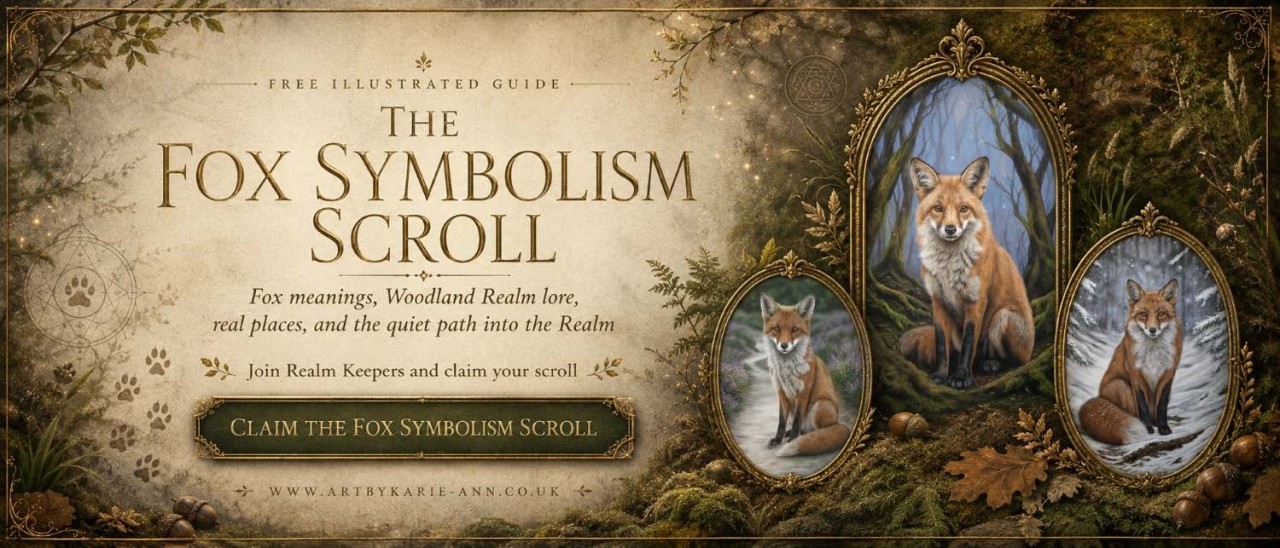
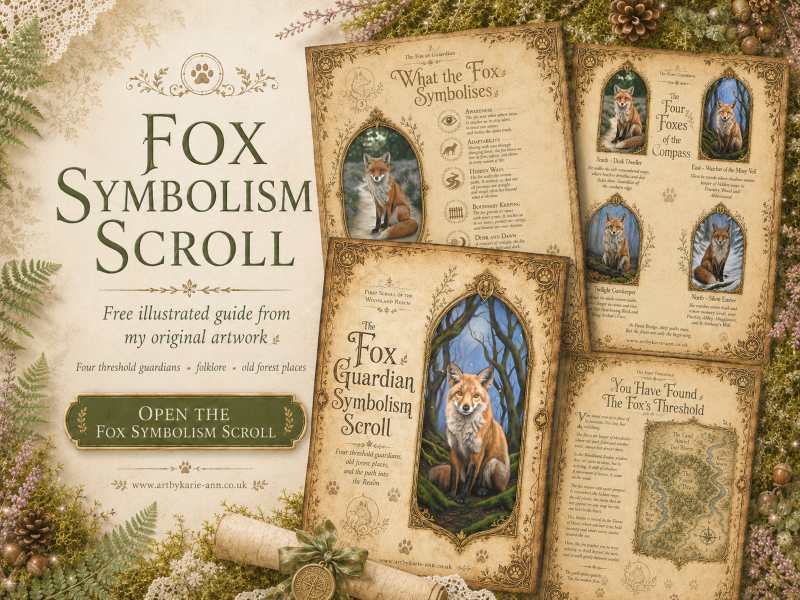
I created a free illustrated Fox Symbolism Guide
for exactly that reason.
The article gives you the meanings.
The guide turns them into something you can keep —
combining fox symbolism, folklore, my original fox artwork,
the Four Foxes of the Compass and the real Forest of Dean places
woven into their stories.
11 illustrated pages. Free to download and yours to keep.
Get the Free Fox Symbolism Guide
The link takes you straight to the signup box. The illustrated PDF is delivered by email.
Although meanings vary between traditions and interpretations,
fox symbolism commonly gathers around a small group of themes.
These meanings make sense when we look at the real animal.
Foxes do not survive through size or physical strength.
They survive by reading their environment well.
They use cover, remember routes, adapt to changing conditions
and know when to disappear.
That is why the fox can feel very different from more forceful
animal symbols.
Its strength is quieter.
It is the strength of noticing.
In British and European storytelling,
the fox is often portrayed as clever, elusive and difficult to outwit.
Sometimes that cleverness is admired.
Sometimes it makes the fox suspicious.
Sometimes the fox wins simply because it notices something that the
stronger animal has overlooked.
This mixture of admiration and mistrust is important.
Fox symbolism is not simply “good” or “bad”.
The animal often occupies the space between those two ideas.
Foxes also belong naturally to edges:
woodland margins, fields, hedgerows, quiet lanes and the meeting
point between wild and human spaces.
They are frequently seen around dawn or dusk,
when the landscape itself feels as though it is changing from one state
into another.
That makes the fox an especially powerful symbol for
thresholds, transitions and uncertain paths.
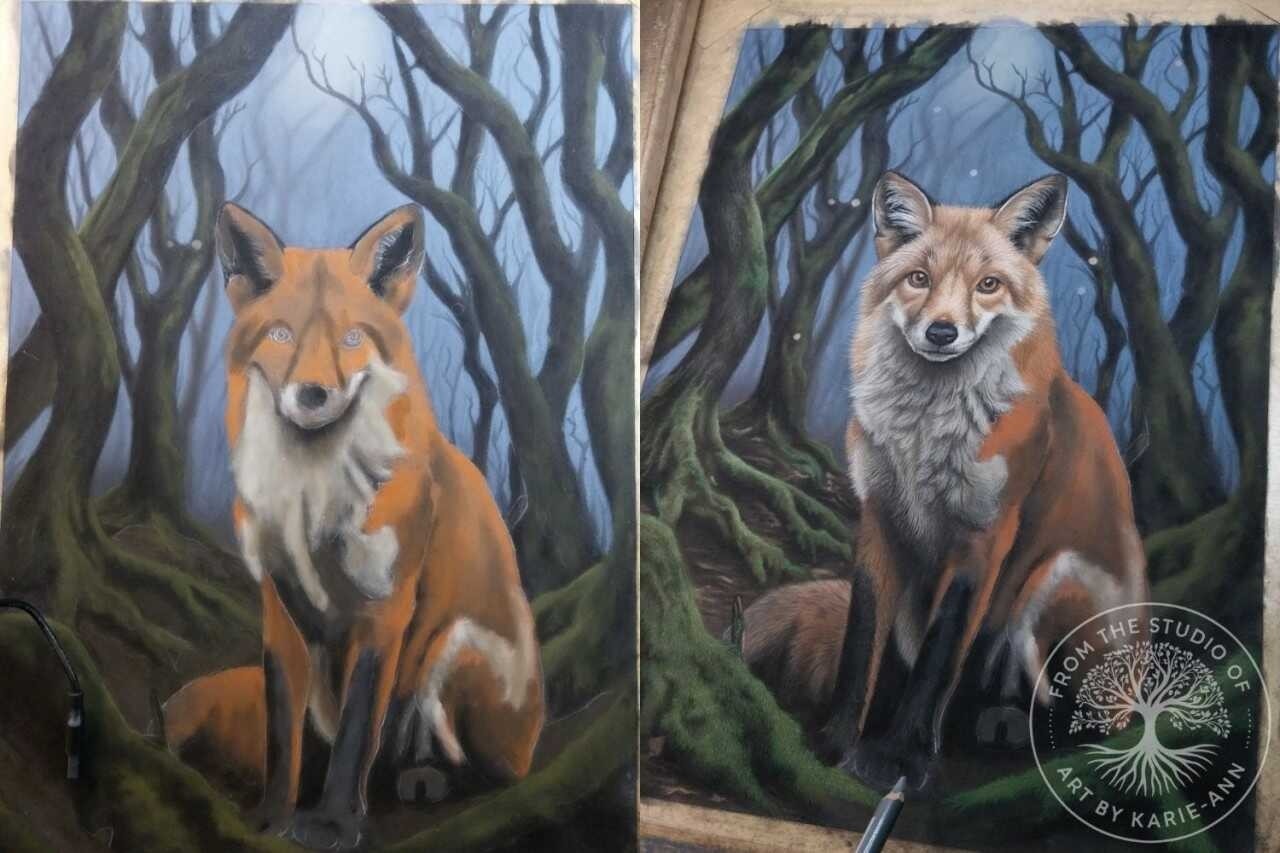
The real landscapes behind much of my own fox artwork come from the
Forest of Dean
,
where woodland tracks, old industrial routes, streams and forest edges
give the fox a landscape that already feels full of crossings and hidden paths.
Want to keep the fox meanings?
The fox’s reputation for cleverness extends far beyond Britain.
Across many storytelling traditions,
foxes appear as animals that survive by intelligence,
observation and understanding the weaknesses of others.
In Japanese folklore, for example,
fox spirits known as kitsune became associated with transformation,
intelligence and supernatural ability.
European fables often place the fox in a different role:
the strategist who finds a way around a problem
that cannot be solved by strength alone.
The stories differ,
but the underlying idea is remarkably persistent:
The fox sees another possibility.
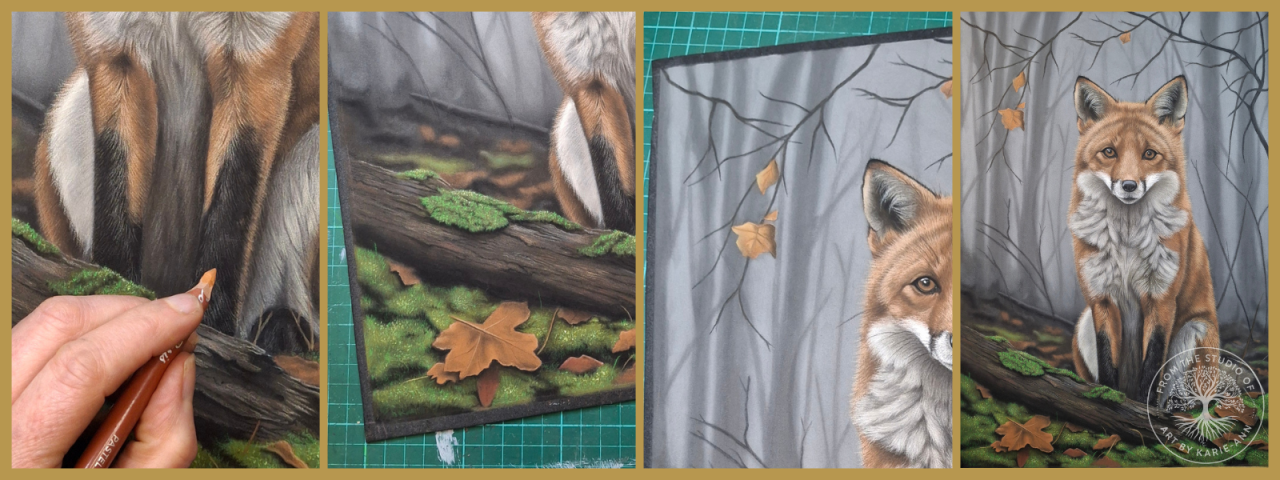
When I began building the Woodland Realm around my British wildlife artwork,
the fox felt like a natural Guardian.
Not because it is the strongest animal in the forest.
Because it notices.
A guardian does not always need to fight.
Sometimes a guardian:
Those qualities fit the fox far better than brute strength ever could.
It also explains why the first Woodland Realm story grew around
the Four Foxes of the Compass
.
Each fox watches a different direction.
Each belongs to a different part of the landscape.
And each interprets the idea of guardianship in a slightly different way.
Realm Whisper
The fox does not guard by force.
If an encounter with a fox has stayed in your mind,
it may be more useful to think about the details of the moment
than to search for one fixed definition.
Ask yourself:
Those details do not turn the animal into an omen.
But they can help explain why the encounter felt important.
A fox waiting quietly may make you think about patience.
A fox disappearing down another path may suggest adaptability.
A fox standing perfectly still and watching you may make awareness
feel like the most important quality of all.
Archive Note
The meaning does not have to be hidden somewhere outside the animal.
If you came to this article because you saw a fox,
wondered what a fox crossing your path might mean,
or simply wanted to understand fox symbolism more deeply,
you now have the main answer.
But the free illustrated guide lets you keep it.
It gathers the meanings into one place,
adds the Four Foxes of the Compass,
introduces the real Forest of Dean locations behind their stories
and turns the symbolism into an illustrated path through the Woodland Realm.
Take the fox meanings beyond this article with an illustrated guide
exploring symbolism, folklore, original fox artwork,
the Four Foxes of the Compass and the real woodland places behind their stories.
11 illustrated pages. Free. Yours to keep.
Get the Free Fox Symbolism Guide
The link takes you straight to the signup box. Free illustrated PDF delivered by email.
🌿 What Does Seeing a Fox Mean? Fox Symbolism & British Folklore
🌿 What does it mean when you see a fox?
🌿 What does it mean when a fox crosses your path?
It is that, for a moment, you stopped long enough to notice it.
Want to keep the fox meanings and explore them more deeply?
🌿 What does a fox symbolize?
🌿 Fox symbolism in British folklore
The free 11-page illustrated Fox Symbolism & Meaning Guide
brings the meanings, folklore, Four Foxes, artwork and woodland places together.
Get the free guide →
🌿 Why foxes appear in stories around the world
🌿 Why the fox became a Woodland Realm Guardian
It guards by knowing the path before you do.
🌿 What should you think about after seeing a fox?
Sometimes it begins by looking more closely at the way the animal lives.
🌿 Take the fox symbolism with you
Keep the Fox Symbolism & Meaning Guide
Choose Your Path Into the Woodland Realm
Categories: : Folklore, Myth, Symbolism